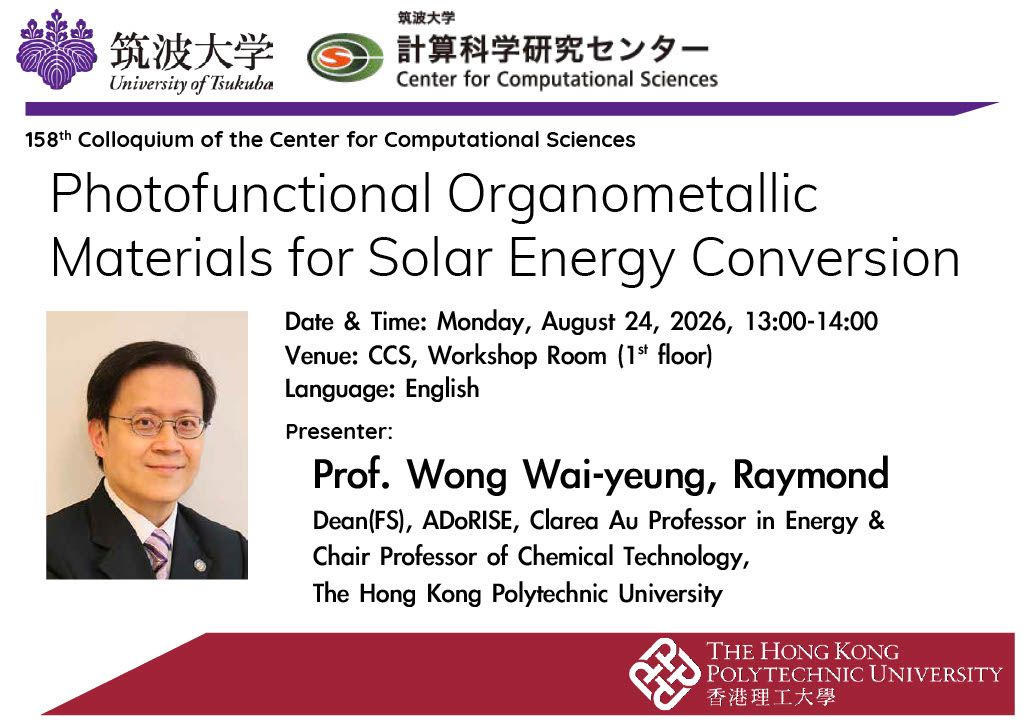
第157回計算科学コロキウムを、4月16日(木)14:00より開催します

第157回計算科学コロキウムを開催いたします。多数のご来聴をお待ちしております。

日時:2026年4月16日(木)14:00〜16:00
   16 April 2026 (Thu) 14:00 ~ 16:00
 
場所:計算科学研究センター 国際ワークショップ室
    CCS, Workshop Room (1st floor)
 
講演者:1) Prof. Huade (Walter) Guan
    2) Doan Quang Van
 
講演内容)
1)Title: Improving Flood Heat and Drought Mitigation with Drywells in Cities
Increasing urbanisation leads to multiple environmental problems in cities, including an increasing likelihood of flash floods, exacerbated heat stress due to the urban heat island effect, and urban forest mortality in droughts. These problems are rooted in urbanisation-induced hydrological alterations, which generally create shortcuts from rainfall to urban streams via impervious surfaces and the formal stormwater drainage network. Green infrastructures, such as drywells, can restore urban hydrological processes. A drywell is a well hanging some distance above the groundwater table receiving stormwater for infiltration. A drywell can be installed in an area as small as a squared meter. They are easy to be implemented in both public and private space. In Adeliade, the capital city of South Australia, drywells are often installed in verges, collecting stormwater via kerbside inlets. They reduce runoff generation in the urban catchment, provide more water for trees in dry season, and enhance canopy transpiration cooling. In this presentation, I will (1) demonstrate the effects of drywells in mitigating flood and heat in suburban areas of Adelaide; (2) discuss the potential of installing drywells in private allotments to benefit garden trees and reduce stormwater generation; and (3) propose using drywells to improve drought resilience of street trees.
 
2) Title: HiClimaX initiative for actionable climate prediction for cities.
The HiClimaX initiative, launched by the Atmospheric Informatics Lab at the University of Tsukuba in collaboration with international partners, advances actionable climate prediction for cities. It integrates multi-paradigm downscaling—dynamical, physics-based, and AI approaches—within a unified, open framework. The platform delivers decision-relevant, high-resolution climate information that captures urban processes, extremes, and uncertainties. By enabling standardized benchmarks and global intercomparison, HiClimaX moves beyond predictive skill toward real-world usability. It emphasizes transparency, uncertainty quantification, and co-development with stakeholders, supporting resilient urban planning, infrastructure adaptation, and climate-informed decision-making under rapidly changing environmental conditions.
 
■ About Prof Guan
Huade (Walter) Guan is a Professor of Environmental Science and Hydrology at Flinders University, and a Chief Investigator of National Centre for Groundwater Research and Training in Australia. His research centres in terrestrial ecohydrology and hydrometeorology, and their applications in catchments, cities, agricultural and mining environments. Prof Guan has published over 150 peer-reviewed articles, with a Scopus h-index of 43. These research activities contribute to the United Nations Sustainable Development Goals: #15 Life on land, #11 Sustainable cities, #13 Climate actions, #6 Clean water, and #2 Zero hunger. Prof Guan is Specialty Chief Editor for Frontiers in Climate (Climate, Ecology and People) (2025-), and was Associate Editor for Journal of Hydrology (2015-2025). 
 

世話人: Doan Quang Van

High-Resolution Cryo-EM Structure Reveals the Mechanisms Underlying Oxygen-Tolerant Energy Conversion in a Marine Photosynthetic Bacterium

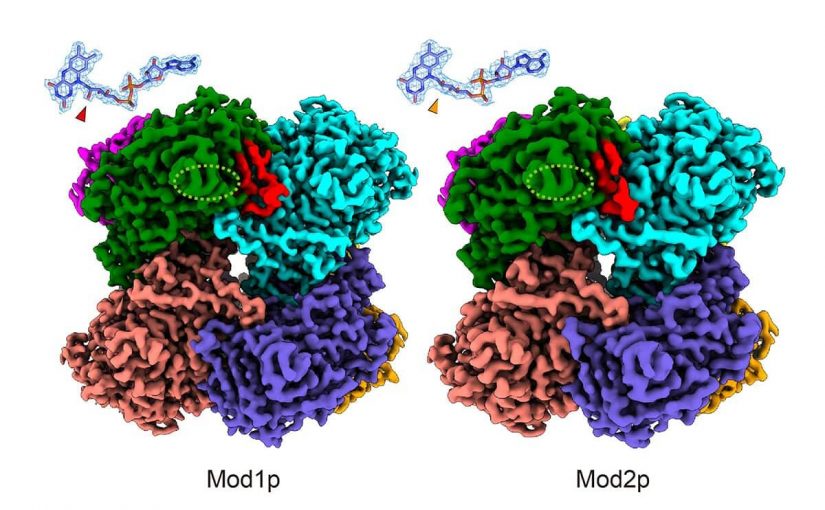
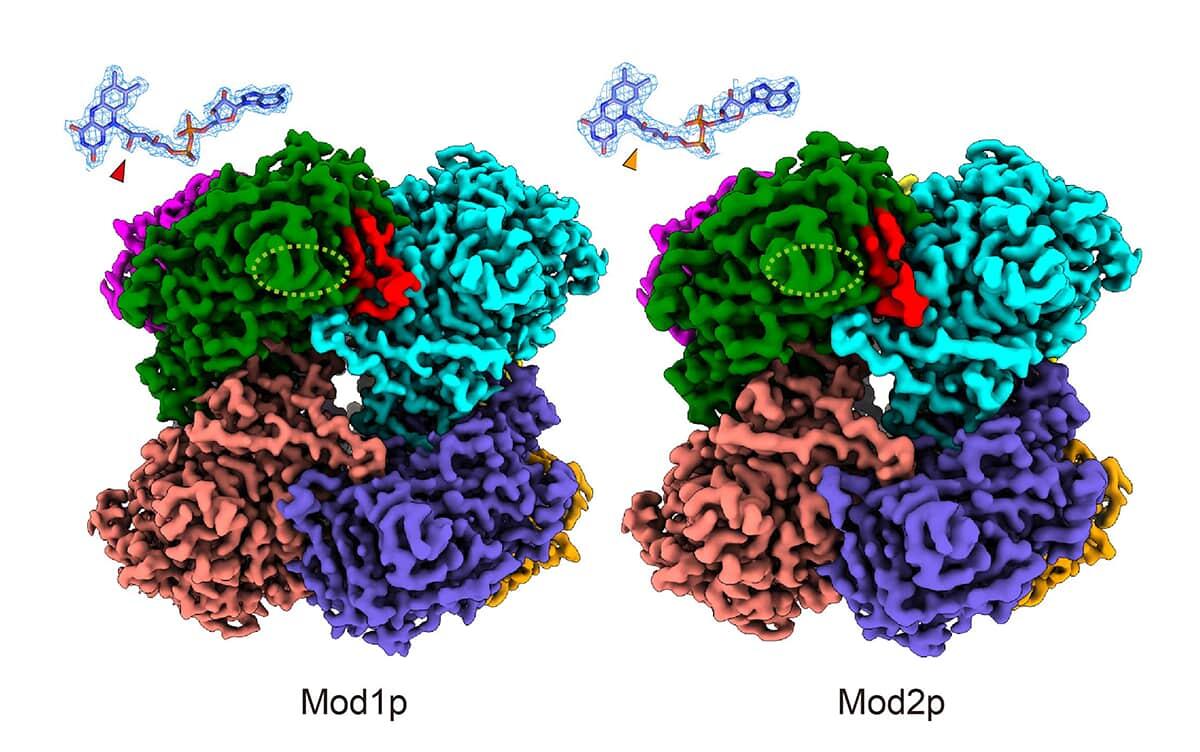
Oxygen is generally harmful to many photosynthetic bacteria; however, certain marine purple nonsulfur bacteria can grow even under oxic conditions. Researchers at University of Tsukuba used cryo-electron microscopy to visualize the structure of the protein complex responsible for photosynthesis in one such bacterium, Rhodovulum sulfidophilum. Their analysis uncovered a previously unrecognized membrane protein and revealed structural features that could explain how this organism achieves efficient energy conversion despite the presence of oxygen.


Tsukuba, Japan—Photosynthetic bacteria do not release oxygen during photosynthesis but can convert solar energy into chemical energy with remarkably high efficiency. They also utilize near-infrared light—wavelengths unused by plants—and thrive in diverse environments, including freshwater, seawater, and hot springs. Among these organisms, the marine purple nonsulfur bacterium Rhodovulum sulfidophilum is a model species notable for its strong tolerance to oxygen. However, the molecular mechanism by which its light-harvesting and energy-converting LH1-RC complex maintains highly efficient photosynthesis under oxic conditions remains unclear.

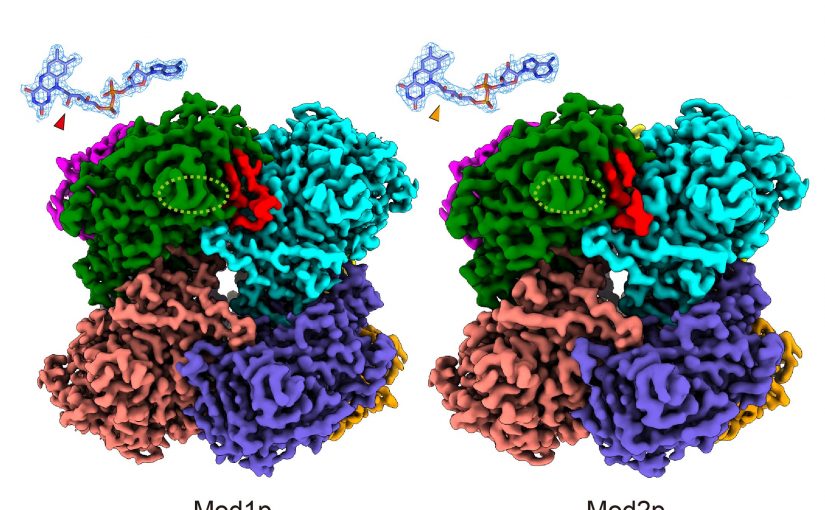
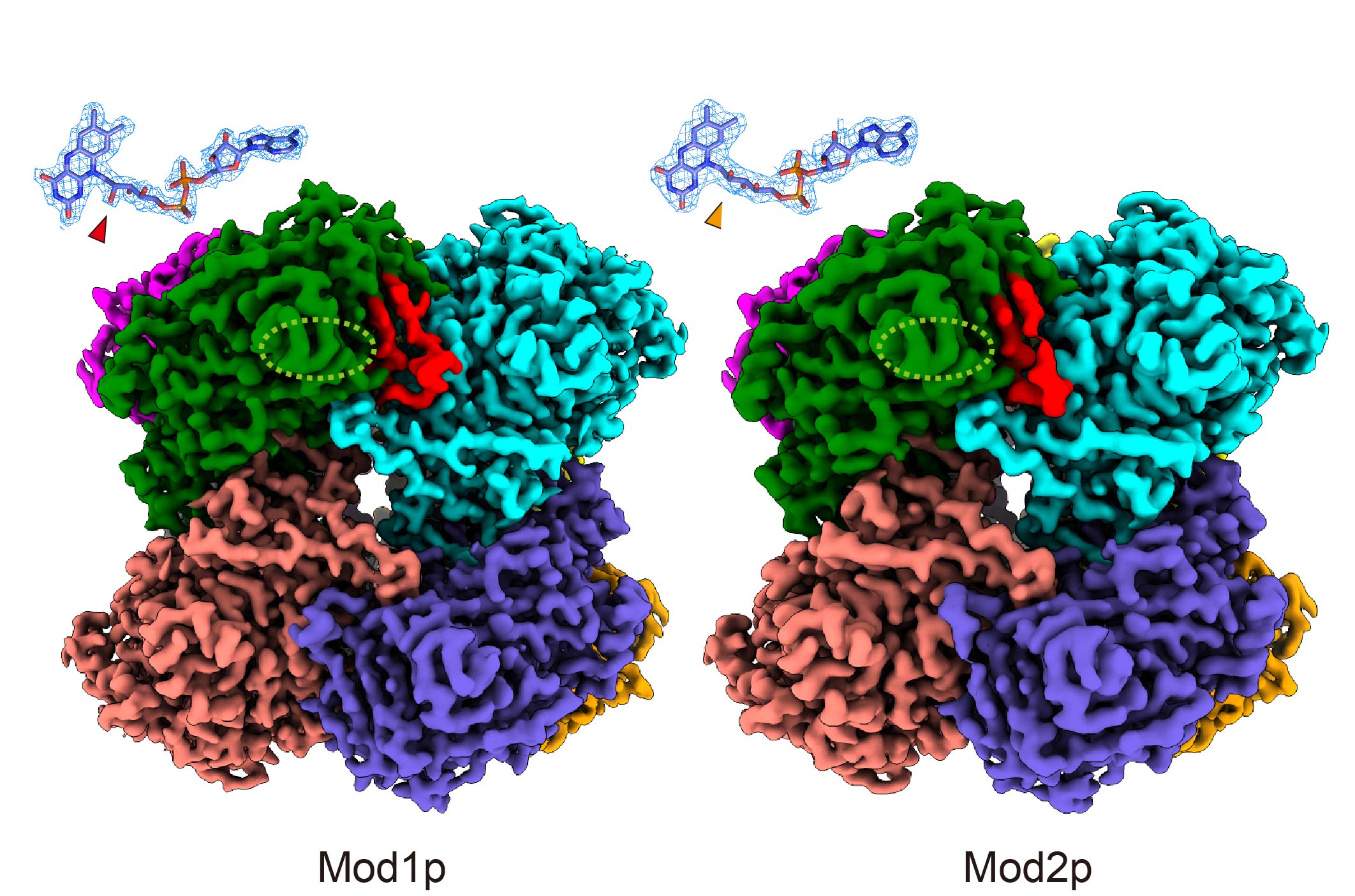
In this study, the researchers determined the structure of the LH1-RC complex at an exceptionally high resolution of 1.8 Å using cryo-EM. Their analysis identified a previously unknown membrane protein called protein‑3h, which is located within the LH1 opening. They further discovered a non-heme Fe ion positioned near the triheme cytochrome subunit, which is coordinated by a histidine residue and water molecules rather than by heme. This configuration indicates that the Fe ion might act as an intermediary site for electron transfer.

These findings provide deeper insight into the photosynthetic complex in R. sulfidophilum and could contribute to future applications, such as genetically engineered phototrophic systems and environmentally relevant technologies, including the bioremediation of hydrogen sulfide-containing wastewater.


###
This research was partially supported by the National Key R&D Program of China (No. 2022YFC3401800), Platform Project for Supporting Drug Discovery and Life Science Research (Basis for Supporting Innovative Drug Discovery and Life Science Research (BINDS)) from AMED under Grant Numbers JP21am0101118 and JP21am0101116, and JP23ama121004. R.K., E.R.P., T. M. and B.M.H. acknowledge the generous supports of Dr. Malgorzata Hall, the Okinawa Institute of Science and Technology (OIST), Scientific Computing & Data Analysis Section and Scientific Imaging Section at OIST and the Japanese Cabinet Office. R.K. acknowledges the support from Prof. Tsumoru Shintake. M.T.M. was supported in part by NASA Cooperative Agreement 80NSSC21M0355. This work was supported in part by JSPS KAKENHI (Grant Numbers 22K06111, 23K05822, 24H02084, 24K01620 and 24H02078), Center for Quantum and Information Life Sciences, University of Tsukuba, and MEXT Joint Usage/Research Promotion Project: CURE JPMXP1323015488 (Spin-L program No spin25XN018).


Original Paper

Title of original paper: 
Structural insights into the photochemistry of the LH1-RC complex from the marine purple phototrophic bacterium Rhodovulum sulfidophilum
 
Journal: Communications Biology
 
DOI: 10.1038/s42003-026-09755-z


Correspondence

Professor TANI Kazutoshi
Center for Computational Sciences, University of Tsukuba

Professor Zheng-Yu Wang-Otomo
Faculty of Science, Ibaraki University

Professor KIMURA Yukihiro
Department of Agrobioscience, Graduate School of Agriculture, Kobe University

Associate Professor MINO Hiroyuki
Department of Physics, Graduate School of Science, Nagoya University

Section Leader MOCHIZUKI Toshiaki
Scientific Imaging Section, Core Facilities, Okinawa Institute of Science and Technology Graduate University (OIST)

EPCC-CCS joint workshop

Date: March 11th (Wed) – 12th (Thu), 2026
Venue: EPCC, the University of Edinburgh

DAY 1 Teaching Room 13,Teviot Medical School
start Speaker  Title
9:30   Coffee, welcome and introduction
10:00 Yoshinari Kameda Computational Vision Media for Real-World Computational Imformatics
10:30 Mark Parsons EPCC  update
11:00 Miwako Tsuji Quantum HPC Hybrid Platform in Japan
11:30   Coffee
12:00 Oliver Brown Quantum Software Lab
12:30 Hiroyasu Koizumi Quantum Computing for Natural Language Processing and Sentiment Analysis
13:00   Lunch
14:00 Jano Van Hemert Edinburgh International Date Facility:flexible storage and compute services for AI  and date science
14:30 Taisuke Boku Changing Lanes – GPU Computing for HPC/AI and Governmental Support in Japan
15:00 Julien Sindt Preserving large-scale geospatial datasets 
15:30   Coffee
16:00 Yasuteru Shigeta Integrated Drug discovery using simulation and machine learning
16:30 Joe O’Connor Machine Learning for Smoothed Particle Hydrodynamics 
16:45 Adrian Jackson Optimizing storage with compiler technologies
17:00   Close


DAY 2 Lecture Theatre 3,  40 George Square
start Speaker  Title
9:00 Nick Brown Programmer productivity and performance when using AI accelerators for HPC
9:30 Ho Hsiao A Machine Learning Approach for Lattice Gauge Fixing
10:00 Elia Cellini Neural and Non-Equilibrium methods for Lattice Gauge Theory
10:30 Dr.Shu Horie Estimating the Star Formation History of Galaxies Using Diffusion Models
11:00   Coffee
11:30 Jindra Gensior  The impact of different star formation models on galaxy evolution across cosmic time
12:00 Paul Batholomew  VECTA and CSS
12:30   Closing remarks and future plans
13:00   Lunch
14:00   Visit to EPCC Data Center
16:30   Close

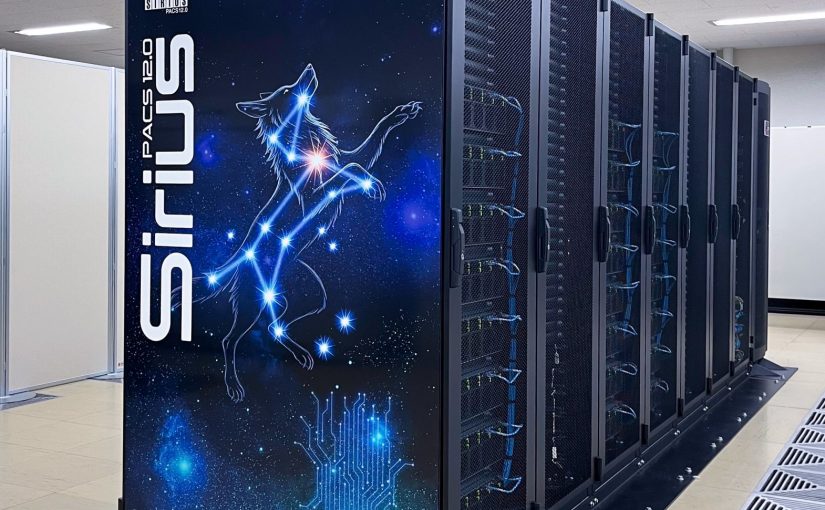
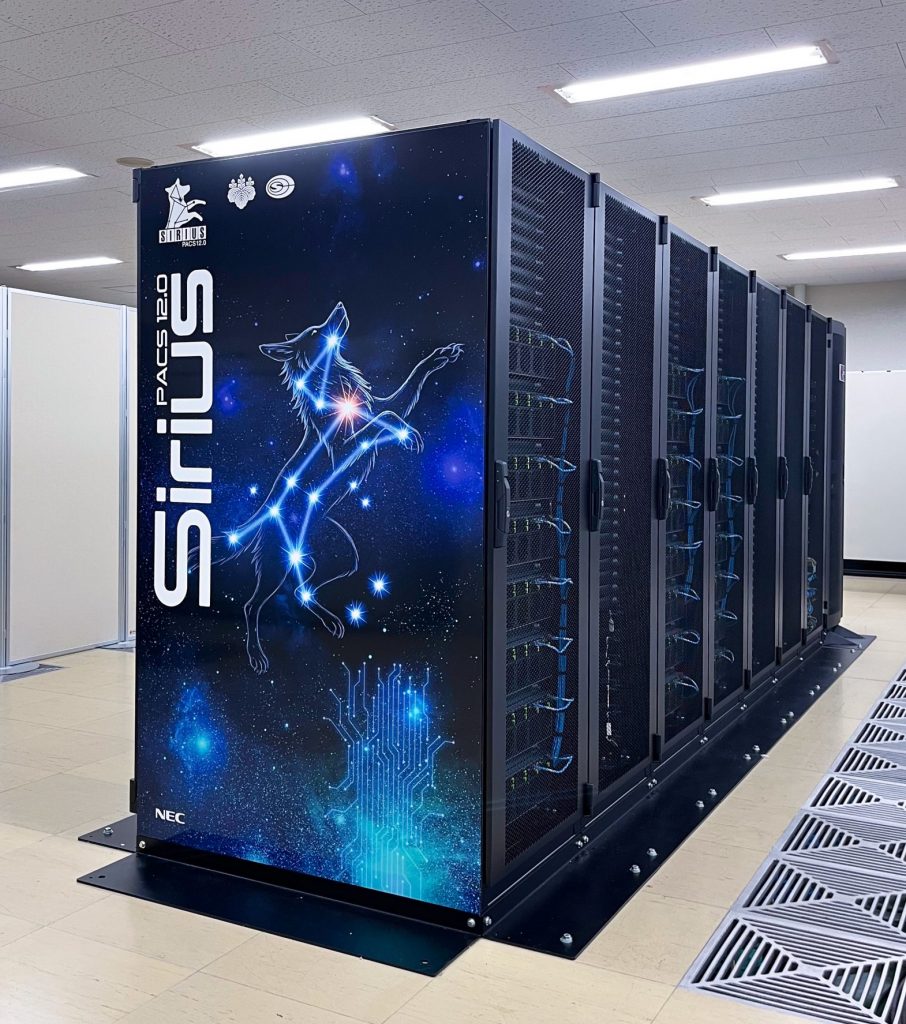
新型スーパーコンピュータ Sirius (PACS12.0) の運用を開始

2026年3月27日
筑波大学計算科学研究センター

ポイント

    1. ユニファイドメモリ型スーパーコンピュータ「Sirius (PACS12.0)(シリウス パックス12.0: 愛称シリウス)」の稼働を令和8年3月27日から開始します
    2. 日本の国立大学で初めて、AMD社製のAPU(CPU/GPU統合プロセッサ)を搭載したスーパーコンピュータとなります
    3. 倍精度浮動小数点の理論ピーク演算性能は11.9 PFlopsです

概要

筑波大学計算科学研究センター(以下CCS)は、ユニファイドメモリ型スーパーコンピュータSirius (PACS12.0) の運用を令和8年3月27日より開始します。

Sirius(PACS12.0)の計算ノードは、4基のAPU(AMD MI300A)で構成されます。APUはCPU(24コアEPYC Zen 4)とGPU(CDNA3)と128GBのHBM3高バンド幅メモリで構成され、CPUとGPU間のメモリ転送が不要となります。これにより飛躍的な演算効率の向上が期待され、またGPUによる最適化のコストが大幅に低下します。4基のAPUで倍精度浮動小数点理論ピーク性能は496TFlops、HBM3の容量は512GBとなります。加えて、計算ノードには4基の3.84TB PCIe Gen5 NVMe SSDが搭載され、大規模データ・ハイパフォーマンスコンピューティング・AI・大規模言語モデルなどの要求にこたえます。Siriusは24ノードで構成され、全体の倍精度浮動小数点理論ピーク性能は11.9PFlopsです。また、各計算ノードは4本のInfiniBand NDR(400Gbps)で接続されています。5.2PBの並列ファイルシステムにより大規模データを高速にアクセスできます。

CCSで2022年から運用されているビッグメモリスーパーコンピュータPegasusとSiriusの並列ファイルシステムはお互いにInfiniBandで接続され高速アクセス可能です。構成の異なる2システムを相互接続して活用することで、タイプの異なるジョブの実行を最適化することが可能です。

CCSは、学際共同利用プログラムや産業利用・一般利用プログラム、国内の大学や研究機関が参画する革新的ハイパフォーマンス・コンピューティング・インフラ(HPCI)などの枠組みを通して、3月27日よりSirius (PACS12.0) の計算資源を広く供し、計算科学・計算機科学・産業の発展に寄与します。


Sirius (PACS12.0) 全体構成イメージ


第156回計算科学コロキウムを、4月1日(水)16:00より開催します

第156回計算科学コロキウムを開催いたします。多数のご来聴をお待ちしております。

講演タイトル:Dynamical Docking and Binding Free Energy via Enhanced Sampling Methods

講師:Andrea Cavalli, Director, Centre Européen de Calcul Atomique et Moléculaire
   Ecole Polytechnique Fédérale de Lausanne (EPFL)

日時:2026年4月1日(水) 16:00-17:00
場所:計算科学研究センター 会議室A

Postdoctoral researcher (Division of Particle Physics)

Affiliation:

Center for Computational Sciences, University of Tsukuba (Division of Particle Physics)

Research field, Content of work:

In accordance with the research plan of the COI-NEXT program, “Sustainable AI Enabled by the Co-creation of Quantum Software, HPC, and Simulation Technologies” (Principal Investigator: Synge Todo, The University of Tokyo; Project Period: October 2022 – March 2032), the selected candidate will engage in the subproject titled “Quantum-Classical Hybrid Algorithms Based on Quantum Embedding.” In collaboration with Shinichiro Akiyama (University of Tsukuba), the candidate will work on the development of quantum information compression techniques leveraging tensor networks, as well as the study of quantum-classical hybrid algorithms utilizing tensor network methods for fermionic systems, among other related topics.

Starting date:

As soon as possible after a hiring decision is made (negotiable).

Terms of employment:

Full-time position with possibility of renewal annually, up until March 31, 2031, upon evaluation of the progress.

Annual Salary:

  • Annual salary of approximately JPY 4,500,000–5,500,000 under an annual salary system (employment conditions are subject to the University’s regulations). Salary level will be determined in accordance with the University’s rules, taking into account the candidate’s professional experience and qualifications.
  • Commuting allowance provided in accordance with the University’s regulations.
  • Enrollment in the Mutual Aid Association of the Ministry of Education, Culture, Sports, Science and Technology (MEXT) (pension and health insurance).
  • Coverage under workers’ compensation insurance and employment insurance.

Working Days and Hours:

  • Five days per week (Monday–Friday), 8:30–17:15 (break from 12:15 to 13:15)
  • Days off: Saturdays, Sundays, national holidays, and the year-end/New Year holidays (December 29 to January 3)
  • In principle, the Discretionary Labor System for Professional Work applies. Under this system, employees are not required to strictly adhere to fixed daily working hours; instead, they are deemed to have worked a standard 7 hours and 45 minutes per day, regardless of the actual hours worked.

Qualifications:

An applicant needs to have a Doctoral Degree or Ph. D at the start of employment.

Application materials:

  • Curriculum Vitae (with photograph)
  • List of research activities (Separate refereed and non-refereed papers in the list)
  • Reprints of major papers (no more than 3, photocopies acceptable, 1 copy each)
  • Summary of research activities (up to about 1000 words)
  • Research plan after the appointment (up to about 1000 words)
  • Names and contact information of two references who can provide an assessment of the applicant
  • Self-Declaration on Specific Categories (the prescribed form can be downloaded from https://www.ccs.tsukuba.ac.jp/reqdocuments/)
  • Consent for the handling and extraterritorial transfer of personal data in accordance with the EU-General Data Protection Regulation (GDPR) (*Submit this form only if you are a resident of member countries of the European Economic Area or the United Kingdom, the prescribed form can be downloaded from https://www.ccs.tsukuba.ac.jp/reqdocuments/)

Selection process:

After screening the application documents, qualified applicants will be invited to have an online interview in Japanese or English.

Selection period:

Until the position is filled

Application submission:

Please indicate “Application for a Postdoctoral Position in Particle Physics” in the subject line and submit a password-protected ZIP file containing documents 1)–8) in PDF format via email to: application-pp[at]ccs.tsukuba.ac.jp (please replace “[at]” with “@”). The password for the ZIP file should be sent separately to: akiyama[at]het.ph.tsukuba.ac.jp (please replace “[at]” with “@”).

If the total file size exceeds 10 MB, please contact the contact person listed below in advance. Please use “Application Documents for SQAI Researcher Position” as the subject line of your email. If you do not receive a confirmation of receipt within two days of submission, please follow up with the contact person below.

Contact Information:

Shinichiro Akiyama
Division of Particle Physics
Center for Computational Sciences
University of Tsukuba
Tel: +81-29-853-6487
Email: akiyama[at]het.ph.tsukuba.ac.jp ([at] should be replaced by @)

Miscellaneous:

  • The personal information in the application documents will be used solely for the purpose of selection. After the selection all the personal information will be properly deleted.
  • The Center for Computational Sciences has been approved as a Joint Collaborative Research Center by the Ministry of Education, Culture, Sports, Science and Technology. We promote interdisciplinary computational sciences, including joint use of our supercomputer systems. The University of Tsukuba conducts its personnel selection process in compliance with the Equal Employment Opportunity Act.
  • The University of Tsukuba has established “University of Tsukuba Security Export Control Regulations” based on “Foreign Exchange and Foreign Trade Act”, and conduct strict examination when employing foreign nationals, persons from foreign universities, companies, government agencies, etc., or persons who fall under a specific category.
  • Smoking is prohibited on the premises in order to prevent exposure to secondhand smoke in the workplace.

素粒子物理研究部門 研究員 (締切 適任者が決まるまで)

公募人員: 研究員 1名

所属組織:計算科学研究センター(素粒子物理研究部門)

専門分野:COI-NEXT「量子ソフトフェアとHPC・シミュレーション技術の共創によるサスティナブルAIが拓く未来」(代表:藤堂眞治(東大)、研究期間:2022年10月〜2032年3月)の研究計画に則り、サブ課題「量子埋め込みに基づく量子古典融合アルゴリズム(量子埋め込み)」に従事する。当該分野の秋山進一郎(筑波大)と協力し、テンソルネットワークを駆使した量子情報圧縮技術の開発、フェルミ粒子系向けのテンソルネットワーク法を活用した量子・古典融合アルゴリズムの研究、などに取り組む。

着任時期:決定後できるだけ早い時期(応相談)

任期:年度更新、最長2031年3月31日まで

給与等

・年収450万円〜550万円程度、年俸制(給与等雇用条件は本学の規定による)。
 候補者の職務経験等を加味し、本学規程に基づいて号俸を決定。
・通勤手当(本学の規定により支給)
・文部科学省共済組合(年金、医療)に加入
・労災保険、雇用保険適用あり

勤務日

・週5日(月~金曜日)8:30-17:15(休憩時間12:15-13:15)
・休日 土曜日、日曜日、国民の祝日及び 12 月 29 日~1 月 3 日
※原則、専門業務型裁量労働制(みなし労働1日7時間45分)が適用されます。

応募資格: 博士の学位を有する方もしくは着任時期までに取得見込の方

提出書類

1)履歴書(写真貼付)

2)全業績リスト(査読論文とその他を区別すること)

3)主な論文別刷(3編以内、コピー可、各1部)

4)これまでの研究の概要(最大2000字程度)

5)着任後の研究に関する抱負(最大2000字程度)

6)本人についての意見を求め得る方2名の氏名及び連絡先

7)特定類型自己申告書(本学所定様式https://www.ccs.tsukuba.ac.jp/reqdocuments/

8)EU―般データ保護規則(GDPR)に基づく個人データの取扱い及び域外移転に関する同意書(※欧州経済領域の構成国及び英国在住者のみ必ず提出、本学所定様式 https://www.ccs.tsukuba.ac.jp/reqdocuments/

選考方法: 提出書類に基づいた書面選考を実施し、通過者は日本語または英語でオンライン面接を行います。

応募期間:適任者の採用が決まるまで

応募方法: 提出書類1)−8)のPDFファイルをzipファイルにまとめてパスワードをかけ、電子メールの添付ファイルとして、下記のアドレス
   application-pp[at]ccs.tsukuba.ac.jp([at]を@に置き換える)
にお送りください。zipファイルのパスワードは、別途下記のアドレス
   akiyama[at]het.ph.tsukuba.ac.jp([at]を@に置き換える)
にお送りください。ファイルサイズの合計が10MBを超える場合は、問合せ先に連絡してください。メールの件名は、「SQAI研究員応募書類」としてください。メール送信後,2日以内に受領確認のメールが届かない場合は、問い合わせ先に連絡してください。

問合せ先
筑波大学計算科学研究センター素粒子物理研究部門 秋山進一郎 
Tel: 029-853-6487
Email: akiyama[at]het.ph.tsukuba.ac.jp([at]を@に置き換える)

その他: 

  1. 応募書類に含まれる個人情報は、本人事選考のみに使用し、他の目的には一切使用しません。選考終了後はすべての個人情報を適切に破棄します。
  2. 計算科学研究センターは、文部科学省共同利用・共同研究拠点に認定されており、計算機共同利用を含む学際計算科学を推進しています。筑波大学では男女雇用機会均等法を遵守した人事選考を行っています。
  3. 本学では、「外国為替及び外国貿易法」に基づき、「国立大学法人筑波大学安全保障輸出管理規則」を定め、外国人、外国の大学・企業・政府機関等出身者又は特定類型該当者の雇用に際し厳格な審査を実施しています。
  4. 就業場所における受動喫煙防止のため、「敷地内禁煙」としています。

2026年度 産業利用公募開始

筑波大学計算科学研究センター(以下本センター)では、JCAHPC が運用するスーパーコンピュータ Miyabi(Miyabi-G: 1,120 ノード、GH200、78.8 PFLOPS, Miyabi-C: 190 ノード、Xeon CPU Max 9480、1.3 PFLOPS)及び本センターが運用するビッグメモリスーパーコンピュータ Pegasus (150 ノード、SPR、H100、不揮発性メモリ、8.1 PFLOPS) 、ユニファイドメモリスーパーコンピュータ Sirius (PACS12.0)(24 ノード、4×MI300A、11.9 PFLOPS)について、 Miyabi の 4%、 Pegasus、 Sirius の 10%を目安とした計算機資源を、 全国共同利用機関における社会貢献の一環として計算科学/工学、AI for Science/Engineering の推進のため産業利用に供することといたします。

応募に際しては以下のページをご確認ください。


第155回計算科学コロキウムを、3月19日(金)10:10より開催します

筑波大学計算科学研究センター生命科学研究部門では、山口兆先生の特別講義を開催します。
お気軽にご参加ください。

題目:高原子価遷移金属オキソ結合の理論と生体関連酸化反応の学理解明:光合成水分解反応機構解明を目指して

講師: 山口 兆 先生(大阪大学量子情報・量子生命研究センター(QIQB))

日程:2026年3月19日(木)10:10~11:25(2限目)

場所:計算科学研究センター 会議室A

概要:高原子価遷移金属オキソ結合(M=O)のオキシルラジカル性(・M-O・)の起源を軌道対称性の破れの理論により解明し、P450、TauDなどの酸化反応機構解明への適用例を紹介する。さらに、高原子価・Mn-O・の関与する光合成水分解4電子酸化反応の学理解明の現状を解説する。

対象:理工学群および生命環境学群の学部生、大学院生、研究員、教員

世話人:庄司 光男

酸素存在下でも生育する光合成細菌の高効率エネルギー変換機構を解明

2026年3月16日
国⽴⼤学法⼈筑波⼤学
国⽴⼤学法⼈茨城⼤学
国⽴⼤学法⼈神⼾⼤学
国⽴⼤学法⼈東海国⽴⼤学機構名古屋⼤学
学校法⼈沖縄科学技術⼤学院⼤学

概要

 多くの光合成細菌にとって酸素は有害ですが、海洋性紅色非硫黄細菌は酸素存在下でも生育できます。この細菌において光合成を担うタンパク質複合体の構造をクライオ電子顕微鏡で観察したところ、新たな膜タンパク質を発見し、酸素存在下でも効率よくエネルギー変換できる仕組みの一端を解明しました。

 光合成細菌は光合成の際に酸素を発生しませんが、太陽光エネルギーを高効率で化学エネルギーへ変換する能力を持ちます。また、植物が利用しない近赤外光を利用でき、淡水や海水、温泉など多様な環境に適応しています。中でも海洋性紅色非硫黄細菌 Rhodovulum sulfidophilum は、酸素存在下でも高い環境耐性を持つモデル生物です。しかし、その光捕集・エネルギー変換を担うタンパク質LH1-RC複合体が高効率な光合成を実現する仕組みは未解明でした。

 本研究では、クライオ電子顕微鏡を用い、1.8 Åという極めて高い分解能でLH1-RC複合体を解析し、未知の膜タンパク質protein-3hを同定しました。さらに、この膜タンパク質の近傍には、ヘム(鉄を中心に持つ環状分子)に結合していない孤立した鉄が存在することを明らかにし、この鉄が電子伝達の中継点として機能する可能性を示しました。これらの知見は、光合成の理解を深めるとともに、遺伝子改変によるバイオテクノロジー応用や、硫化水素を含む排水処理など環境インフラ維持への貢献につながると期待されます。

>> プレスリリース全文はこちら


掲載論文

【題名】 
Structural insights into the photochemistry of the LH1-RC complex from the marine purple phototrophic bacterium Rhodovulum sulfidophilum
(海洋性紅色光合成細菌 Rhodovulum sulfidophilum由来LH1-RC 複合体の構造学的知見)
 
【掲載誌】
Communications Biology
 
【DOI】
10.1038/s42003-026-09755-z


Watching the Dance of Molecules in the Cloud

Anyone can do dynamic docking, watching molecules bind in motion.
Researchers at the Center for Computational Sciences, University of Tsukuba, have developed an accessible platform to overcome the limitations of conventional static docking simulations, offering new avenues for education, training, and reproducible research in molecular recognition and supramolecular chemistry. Their Distance-Guided Fully Dynamic Docking (DFDD) platform is a cloud-ready simulation framework that enables students and researchers to explore dynamic docking, visualize molecular binding in motion, and understand how host-guest crystal structures emerge from molecular interactions.

Tsukuba, Japan—Understanding how molecules bind is central to chemistry, biology, and drug design. Nevertheless, most existing tools provide either static snapshots or require computational resources beyond the reach of many researchers and students. Molecular recognition is driven by continuous motion, with flexibility and solvent-mediated interactions playing key roles. However, molecular binding is often interpreted from static crystal structures in conventional docking methods, which typically treat molecules as rigid objects, resulting in many binding pathways remaining poorly captured. While the classical molecular dynamics (cMD) simulations can describe these continuous processes, their high computational cost and limited reproducibility constrain their widespread use.


This work demonstrates how realistic binding pathways and crystal-like structures can be accurately captured using short, reproducible simulations that run on accessible cloud platforms, also in the tablet, offering a practical framework with immediate applicability to learning, teaching, and research. Distance-Guided Fully Dynamic Docking (DFDD) reproducibly recovers binding structures that closely match experimentally determined crystal structures, while also revealing transient configurations that are inaccessible using static docking. DFDD achieved faster convergence, higher reproducibility, and substantially reduced computational effort compared to cMD simulations initiated from unbound states.


DFDD eliminates the need for specialized hardware or complex software installation. It is designed to run on widely accessible cloud platforms, such as Google Colab. By bridging static structural models and fully dynamic simulations, DFDD provides a practical educational and research framework, making dynamic docking accessible to all. With DFDD, everyone can watch molecules bind as crystal-like structures emerge from molecular motion. DFDD is freely available at: https://github.com/nyelidl/DFDD.


###
This research was supported by JSPS KAKENHI Grant Numbers 21H05269 and 24K20888, the JST-CREST project (Grant Number JPMJCR20B3), and the Center for Quantum Information and Life Science (QiLS) at the University of Tsukuba.


Original Paper

Title of original paper: DFDD: A Cloud-Ready Tool for Distance-Guided Fully Dynamic Docking in Host-Guest Complexation 
Journal: Journal of Chemical Information and Modeling
DOI: 10.1021/acs.jcim.5c02852


Correspondence

Assistant Professor HENGPHASATPORN Kowit
Assistant Professor Lian Duan
Associate Professor HARADA Ryuhei
Professor SHIGETA Yasuteru
Center for Computational Sciences, University of Tsukuba


Related Link

GitHub: https://github.com/nyelidl/DFDD
Google Colab: https://colab.research.google.com/drive/1FfTuVSykgsstjzN0nJN0ZQo1_tw0WXSe?usp=sharing

朴泰祐先生に計算科学研究センターフェローの称号を授与しました。

去る3月9日、本年度末で定年退職される朴泰祐教授(高性能計算システム研究部門)へ、計算科学研究センターフェローの称号が授与されました。

朴教授は、計算科学研究センターの前身である計算物理学研究センターの創設時より、センターで開発・運用された数々のスーパーコンピュータの研究開発に尽力され、高性能計算分野における教育・研究の進展に多大な貢献をされました。また、宇宙、物性、気象などのアプリケーション分野との共同研究や多くの国際的な共同研究を推進し、幅広い学術分野の発展に寄与されました。
計算科学研究センターにおいては、2019年度から2024年度までの6年間にわたりセンター長を務め、センターの管理運営ばかりでなく、日本の計算科学の推進において多大な貢献をされました。これらの功績により、計算科学研究センターからフェローの称号を授与されました。

■筑波大学計算科学研究センター フェローの一覧
http://www.ccs.tsukuba.ac.jp/ccs_introduction/teacher/fellow

重田センター長(左)より朴教授へ計算科学研究センターフェローの賞状を授与

計算科学研究センターフェローの賞状を手にする朴泰祐教授


EPCC-CCS joint workshop

今年の EPCC-CCS workshop 開催地は、エジンバラ大学(EPCC)です。

Date: March 11th (Wed) – 12th (Thu), 2026
Venue: EPCC, the University of Edinburgh

DAY 1 Teaching Room 13,Teviot Medical School
start Speaker  Title
9:30   Coffee, welcome and introduction
10:00 Yoshinari Kameda Computational Vision Media for Real-World Computational Imformatics
10:30 Mark Parsons EPCC  update
11:00 Miwako Tsuji Quantum HPC Hybrid Platform in Japan
11:30   Coffee
12:00 Oliver Brown Quantum Software Lab
12:30 Hiroyasu Koizumi Quantum Computing for Natural Language Processing and Sentiment Analysis
13:00   Lunch
14:00 Jano Van Hemert Edinburgh International Date Facility:flexible storage and compute services for AI  and date science
14:30 Taisuke Boku Changing Lanes – GPU Computing for HPC/AI and Governmental Support in Japan
15:00 Julien Sindt Preserving large-scale geospatial datasets 
15:30   Coffee
16:00 Yasuteru Shigeta Integrated Drug discovery using simulation and machine learning
16:30 Joe O’Connor Machine Learning for Smoothed Particle Hydrodynamics 
16:45 Adrian Jackson Optimizing storage with compiler technologies
17:00   Close


DAY 2 Lecture Theatre 3,  40 George Square
start Speaker  Title
9:00 Nick Brown Programmer productivity and performance when using AI accelerators for HPC
9:30 Ho Hsiao A Machine Learning Approach for Lattice Gauge Fixing
10:00 Elia Cellini Neural and Non-Equilibrium methods for Lattice Gauge Theory
10:30 Shu Horie Estimating the Star Formation History of Galaxies Using Diffusion Models
11:00   Coffee
11:30 Jindra Gensior  The impact of different star formation models on galaxy evolution across cosmic time
12:00 Paul Batholomew  VECTA and CSS
12:30   Closing remarks and future plans
13:00   Lunch
14:00   Visit to EPCC Data Center
16:30   Close

計算から実験まで―様々な手法による暑熱環境評価

浅野 裕樹 硏究員

地球環境研究部門

浅野さんは、地球環境研究部門の研究者です。都市気候と山岳気象、この2つを主な専門分野にしながら、近年は理科教育の研究にも励んでいます。幅広い興味関心を持つ浅野さんは、多分野において、さまざまな手法を用いた研究を行ってきました。今回は、その中で特に暑熱分野の研究に注目します。

(2026.2.19 公開)

City-LESの利用を、誰でももっと簡単に

 当センターの日下研究室で開発された都市街区気象モデル「City-LES*」は、都市街区内の気温や風速、表面温度などを詳細に再現することができます。

*LES(Large Eddy Simulation):乱流の数値シミュレーション手法の1つ。
( 参考:https://www.ccs.tsukuba.ac.jp/research-topic-v17/

図1:City-LESによってシミュレートされた東京駅周辺の地上気温分布(出典:日下研究室)


 しかし、図のような現実の街でCity-LESを利用するには、1つのハードルが存在します。それは、シミュレーションを行う上で必要となる都市の三次元モデルの作成です。具体的には、建物などのデータの取得や処理、LESの実行に至るまでに、GIS(地理情報システム:Geographic Information System)の知識と使用経験が求められ、複雑な工程を踏む必要がありました。

 City-LESの利用におけるハードルを下げることは、浅野さんが課題と感じてきた部分でした。その解決の糸口となったのが、竹中技術研究所の藤原邦彦さんが開発した、都市の三次元モデルを生成するPythonパッケージ「VoxCity」です。その大きな特徴は、データの自動取得による利便性と初心者でも扱いやすい操作性の高さにあります。VoxCityの活用により、シミュレーションに必要な土地利用や建物データは、クリック操作で簡単に取り出せるようになりました。都市名や地域を選べば、日本だけでなく世界各国の都市においてもデータ取得が可能となります。

図2:VoxCityによるデータ処理のフロー(出典:Fujiwara et al.(2025))
VoxCityは、現在公開ページから誰でも利用することが可能。https://github.com/kunifujiwara/VoxCity


 浅野さんが国際会議で藤原さんの発表を聞いたことをきっかけに、その技術をCity-LESにも応用できるのではないかと思い、声をかけたそうです。その結果、両技術を結びつけ、City-LESの利便性を高める共同開発へと発展しました。今までの複雑な手作業が大幅に削減され、より効率的にシミュレーションを行うことが可能となったのです。浅野さんは、引き続き暑熱環境評価の研究に取り組んでおり、この開発をきっかけにCity-LESのさらなるユーザー拡大を期待しています。

シミュレーションから観測まで…多岐に渡るアプローチ

 浅野さんは、City-LESなどの数値モデルを用いた研究だけでなく、観測や被験者実験といった、異なる手法での研究も行っています。Asano et al.(2022)では、筑波大学内における被験者実験を通じて、暑い屋外における歩行時間と知的生産性の低下の関係について示しました。実験の結果、被験者の屋外歩行後のテスト正答率は歩く前に比べて3.6%低下しました。また、女性よりも男性で影響が強く見られることや、睡眠時間が短いほど正答率が下がるといった結果も示されています。

図3:筑波大学内での被験者実験の様子(出典:Asano et al.(2022))
プレスリリース:https://www.ccs.tsukuba.ac.jp/release20220222/


後記

 取材を通じて、最先端のシミュレーション実験(モデル)から実証的な実験(観測)まで、浅野さんの取り組む研究アプローチの幅広さが印象的でした。複数の軸を持ちながらも、探究心を持ってそれぞれを極めていこうとする浅野さんの今後の活動に、ますます期待が高まります。

(文・広報サポーター 野本実奈)

さらに詳しく知りたい人へ

令和7年度 年次報告会(2026年2月24日)

日時:2026年2月24日(火)13:30~16:30
会場:計算科学研究センターワークショップ室

計算科学研究センター 令和7年度年次報告会を行います。本年度も引き続きポスター発表となります。

プログラム(コアタイム)         

2026.2.17 更新

所属部門 氏名 コアタイム
素粒子物理研究部門 藏増 嘉伸 13:30-14:30
素粒子物理研究部門 石塚 成人 14:30-15:30
素粒子物理研究部門 大野 浩史 15:30-16:30
素粒子物理研究部門 秋山 進一郎 動画対応
宇宙物理研究部門 大須賀 健 14:30-15:30
宇宙物理研究部門 森 正夫 15:30-16:30
宇宙物理研究部門 矢島 秀伸 13:30-14:30
宇宙物理研究部門 吉川 耕司 14:30-15:30
宇宙物理研究部門 Alexander Wagner 15:30-16:30
宇宙物理研究部門 福島 肇 13:30-14:30
原子核物理研究部門 中務 孝 14:30-15:30
原子核物理研究部門 清水 則孝 15:30-16:30
原子核物理研究部門 日野原 伸生 13:30-14:30
原子核物理研究部門 宮城 宇志 14:30-15:30
量子物性研究部門 大谷 実 15:30-16:30
量子物性研究部門 小泉 裕康 13:30-14:30
量子物性研究部門 Tong Xiao-Min 14:30-15:30
量子物性研究部門 前島 展也 15:30-16:30
量子物性研究部門 萩原 聡 13:30-14:30
生命科学研究部門・生命機能情報分野 重田 育照 14:30-15:30
生命科学研究部門・生命機能情報分野 谷 一寿 15:30-16:30
生命科学研究部門・生命機能情報分野 庄司 光男 13:30-14:30
生命科学研究部門・生命機能情報分野 原田 隆平 14:30-15:30
生命科学研究部門・生命機能情報分野 Kowit Hengphasatporn 動画対応
生命科学研究部門・分子進化分野 稲垣 祐司 15:30-16:30
生命科学研究部門・分子進化分野 中山 卓郎 14:30-15:30
地球環境研究部門 日下 博幸 13:30-14:30
地球環境研究部門 ドアン グアン ヴァン 15:30-16:30
高性能計算システム研究部門 朴 泰祐 14:30-15:30
高性能計算システム研究部門 高橋 大介 13:30-14:30
高性能計算システム研究部門 建部 修見 動画対応
高性能計算システム研究部門 額田 彰 15:30-16:30
高性能計算システム研究部門  辻 美和子 13:30-14:30
高性能計算システム研究部門 多田野 寛人 14:30-15:30
高性能計算システム研究部門 藤田 典久 15:30-16:30
計算情報学研究部門・データ基盤分野 天笠 俊之 15:30-16:30
計算情報学研究部門・データ基盤分野 塩川 浩昭 13:30-14:30
計算情報学研究部門・データ基盤分野 堀江 和正 14:30-15:30
計算情報学研究部門・データ基盤分野 サーヴォン・ブー 動画対応
計算情報学研究部門・計算メディア分野 亀田 能成 13:30-14:30
計算情報学研究部門・計算メディア分野 北原 格 15:30-16:30
計算情報学研究部門・計算メディア分野 謝 淳 13:30-14:30

CCS signs collaboration agreement with KISTI

The Center for Computational Sciences (CCS), University of Tsukuba, has solidified a significant partnership with the Korea Institute of Science and Technology Information (KISTI) on January 26, 2026.

KISTI is a national research institute in Korea responsible for the country’s scientific and technical information infrastructure and supercomputing.

Since 2014, CCS has jointly organized annual in-person winter schools and research exchange workshops with KISTI, alternately held in Japan and Korea. During the COVID-19 pandemic, these activities were temporarily suspended or held online.

Building on this renewed agreement, the two institutions will further strengthen information sharing, collaborative research, and encourage academic exchange, mainly in the field of high-performance computing (HPC), and will continue to work together to advance science.


韓国科学技術情報硏究院(KISTI)とのMOU調印式

筑波大学計算科学研究センター(CCS)は、2026126日、韓国科学技術情報硏究院(KISTI)との部局間交流協定を締結しました。

KISTIは、韓国における科学技術情報の高度化を支えるとともに、国家スーパーコンピューティング基盤の構築・運用を担う国立研究機関です。

CCS2014年以降、コロナ禍による一時的な中断やオンライン開催を経ながらも、毎年対面を基本として、KISTIと共同で日韓両国において交互に合同ウィンタースクールおよび研究交流ワークショップを開催しています。

今後も主にHPC分野の研究を軸に、情報交換や共同研究、人材交流をさらに深化させ、両機関が連携して科学の発展に貢献していきます。