
*第153回計算科学コロキウムは中止となりました(2026.1.14追記)*
第153回計算科学コロキウムを開催いたします。多数のご来聴をお待ちしております。
講演タイトル:Enzyme Mechanism, Dynamics and Evolution — from Drug Resistance to Protein Design and Engineering
講演者:Prof. Adrian J. Mulholland (Centre for Computational Chemistry, School of Chemistry, University of Bristol)
Website: https://mulhollandgroup.wordpress.com/
日時:2026年1月21日(水)9:20-10:05
場所:計算科学研究センター ワークショップ室
言語:英語
Research Interests (proposed wording):
Computational enzymology, QM/MM simulations, reaction mechanisms, enzyme evolution, drug resistance, and computational design of biomolecular systems.
講演内容:
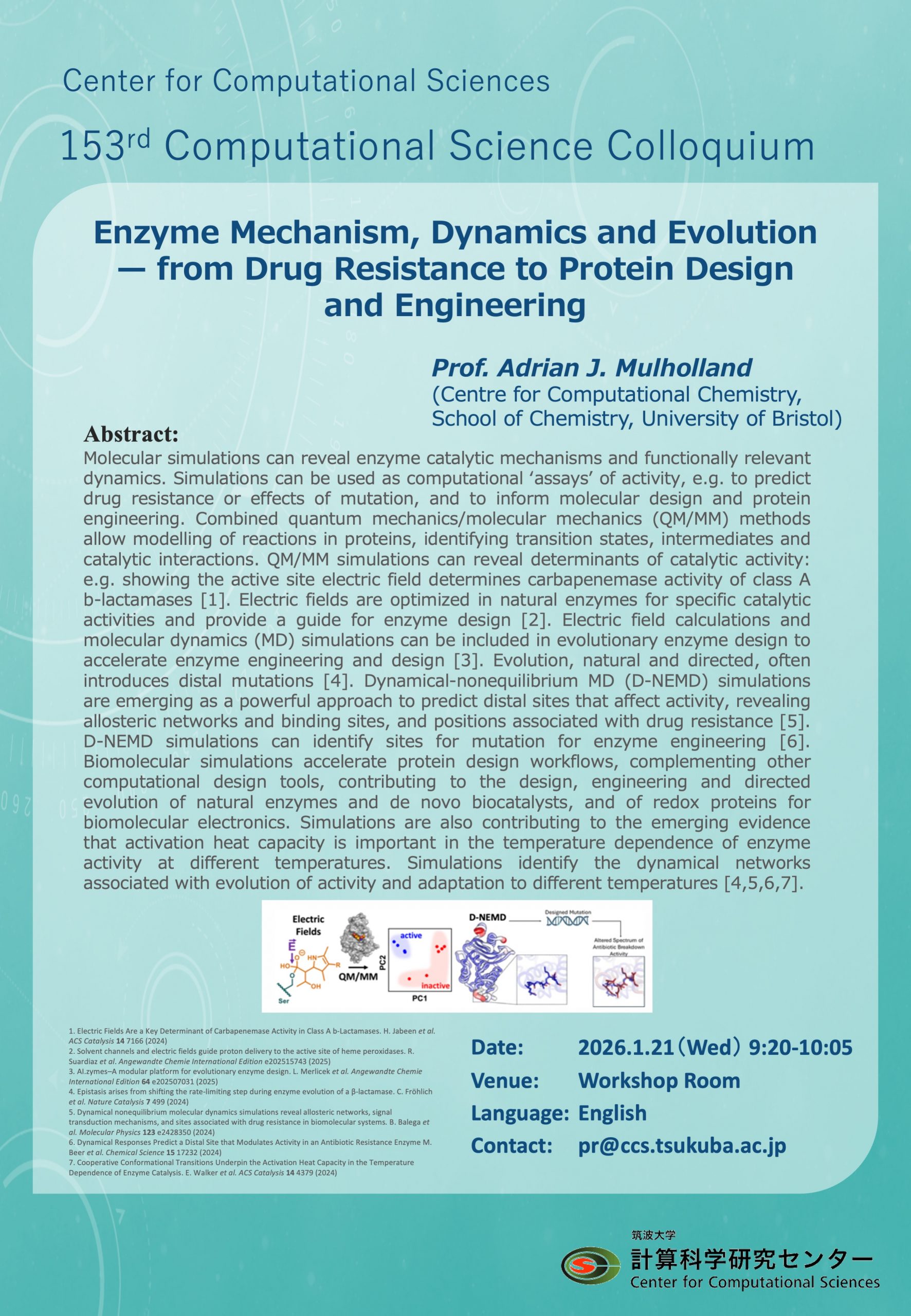
Molecular simulations can reveal enzyme catalytic mechanisms and functionally relevant dynamics. Simulations can be used as computational ‘assays’ of activity, e.g. to predict drug resistance or effects of mutation, and to inform molecular design and protein engineering. Combined quantum mechanics/molecular mechanics (QM/MM) methods allow modelling of reactions in proteins, identifying transition states, intermediates and catalytic interactions. QM/MM simulations can reveal determinants of catalytic activity: e.g. showing the active site electric field determines carbapenemase activity of class A b-lactamases [1]. Electric fields are optimized in natural enzymes for specific catalytic activities and provide a guide for enzyme design [2]. Electric field calculations and molecular dynamics (MD) simulations can be included in evolutionary enzyme design to accelerate enzyme engineering and design [3]. Evolution, natural and directed, often introduces distal mutations [4]. Dynamical-nonequilibrium MD (D-NEMD) simulations are emerging as a powerful approach to predict distal sites that affect activity, revealing allosteric networks and binding sites, and positions associated with drug resistance [5]. D-NEMD simulations can identify sites for mutation for enzyme engineering [6]. Biomolecular simulations accelerate protein design workflows, complementing other computational design tools, contributing to the design, engineering and directed evolution of natural enzymes and de novo biocatalysts, and of redox proteins for biomolecular electronics. Simulations are also contributing to the emerging evidence that activation heat capacity is important in the temperature dependence of enzyme activity at different temperatures. Simulations identify the dynamical networks associated with evolution of activity and adaptation to different temperatures [4,5,6,7].
1. Electric Fields Are a Key Determinant of Carbapenemase Activity in Class A b-Lactamases. H. Jabeen et al. ACS Catalysis 14 7166 (2024)
2. Solvent channels and electric fields guide proton delivery to the active site of heme peroxidases. R. Suardiaz et al. Angewandte Chemie International Edition e202515743 (2025)
3. AI.zymes–A modular platform for evolutionary enzyme design. L. Merlicek et al. Angewandte Chemie International Edition 64 e202507031 (2025)
4. Epistasis arises from shifting the rate-limiting step during enzyme evolution of a β-lactamase. C. Fröhlich et al. Nature Catalysis 7 499 (2024)
5. Dynamical nonequilibrium molecular dynamics simulations reveal allosteric networks, signal transduction mechanisms, and sites associated with drug resistance in biomolecular systems. B. Balega et al. Molecular Physics 123 e2428350 (2024)
6. Dynamical Responses Predict a Distal Site that Modulates Activity in an Antibiotic Resistance Enzyme M. Beer et al. Chemical Science 15 17232 (2024)
7. Cooperative Conformational Transitions Underpin the Activation Heat Capacity in the Temperature Dependence of Enzyme Catalysis. E. Walker et al. ACS Catalysis 14 4379 (2024)
世話人:Kowit Hengphasatporn