
Developing and operating a supercomputer through co-design
Head: TATEBE Osamu, Professor, Ph.D.
The High-Performance Computing System Development and Operation Office designs and develops supercomputers through a co-designing process with applications from the Divisions of Particle Physics, Astrophysics, Nuclear Physics, Quantum Condensed Matter Physics, Life Sciences, Global Environmental Science, and Computational Informatics before actually operating them at the CCS. In designing a supercomputer, it is important to improve not only the computing performance but also the application performance, which requires improving computing, memory, network, and storage performance in a well-balanced manner. In addition, the use of computing acceleration mechanisms is becoming essential to improve the computing and memory performance, yet the application side must take action to fully utilize the performance. A co-design process that considers the development of the computer side and the application side simultaneously will improve the application performance and lead to developments in computational science, data-driven science, and AI-driven science.
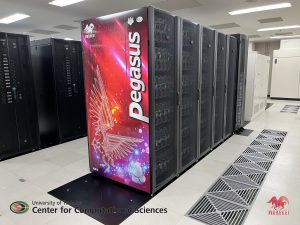
In December 2022, we introduced Pegasus, a big memory supercomputer with GPU and persistent memory. Not only has the computing performance been improved by using state-of-the-art CPUs and GPUs, but DDR5 memory has been installed to greatly increase memory bandwidth, which is essential for improving application performance. It is also equipped with persistent memory to expand memory capacity and improve storage performance, which is especially important for data-driven and AI-driven science. User authentication incorporates two-factor authentication for enhanced security, and access is available via Jupyterhub and Nextcloud for improved convenience. The system started its operation in April 2023.
(Update: June 16, 2026)